22 Oct 2026
Synchronizing Global Odds Feeds to Capture Multi-Sport Arbitrage in Transatlantic Match Windows
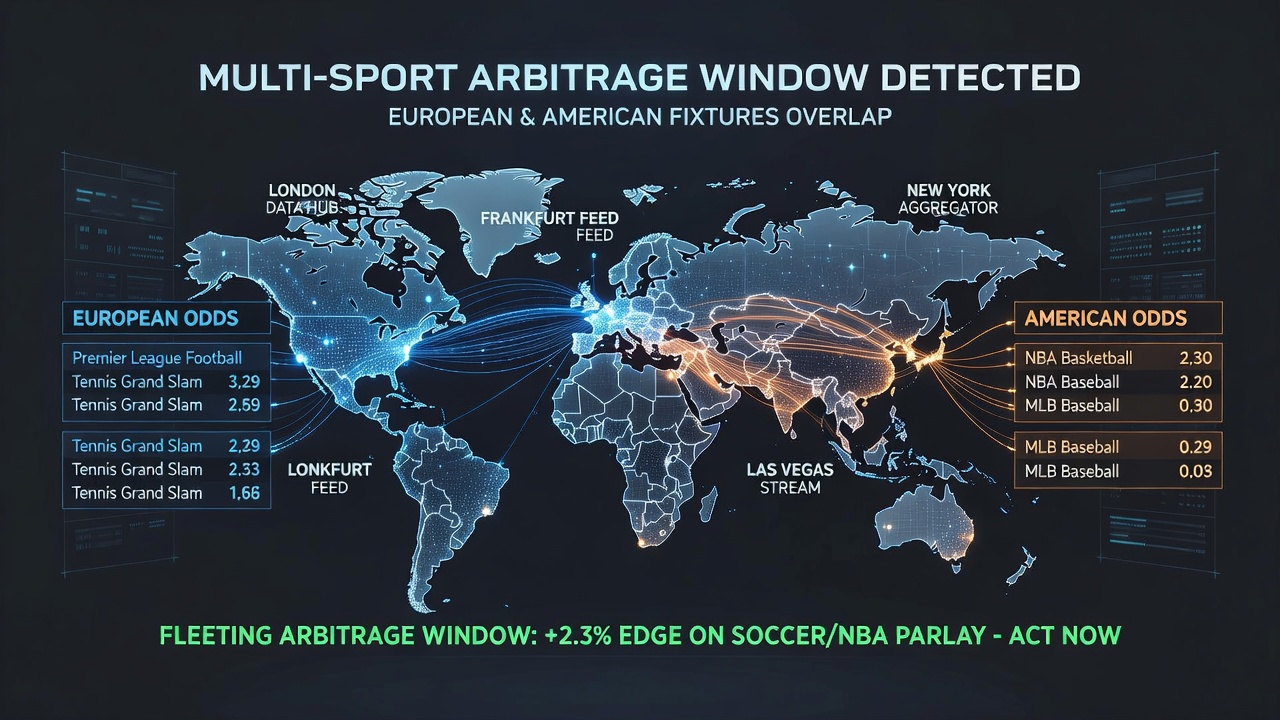
Bookmakers across Europe and North America update live odds continuously during major fixture overlaps, and specialized platforms pull these streams into unified systems that detect price discrepancies within seconds. Data centers positioned in London, Frankfurt, and New York maintain low-latency connections to multiple operators so that a single soccer match in the Champions League and an NBA game starting two hours later can feed into the same comparison engine without timing gaps.
Technical Infrastructure Behind Cross-Continent Feed Aggregation
Operators deploy redundant API endpoints and WebSocket channels that pull decimal, American, and fractional odds formats simultaneously, converting each to a common probability scale before storage. Time-stamp normalization becomes essential because a market movement recorded at 20:14:37 UTC in Paris must align precisely with a shift logged at 15:14:37 EST in New Jersey. Middleware layers apply millisecond-level corrections using NTP servers located on both sides of the Atlantic, which prevents false positives that arise from clock drift.
European football leagues often kick off between 17:00 and 21:00 local time while American basketball and baseball games dominate evening slots in Eastern and Central zones. When these windows coincide, arbitrage windows lasting between 90 and 240 seconds appear across three or four bookmakers. Systems that ingest feeds from at least eight operators in the UK, Germany, Spain, and the United States routinely flag these brief mismatches before liquidity providers adjust lines.
Handling Overlapping Fixtures in October 2026
October 2026 features Champions League group-stage matches on Tuesday and Wednesday evenings that overlap with NBA opening-week games and MLB playoff contests. Observers note that liquidity on major tennis tournaments in Asia adds another layer when European night sessions finish just as US West Coast markets open. Feed-synchronization engines tag each event with sport, league, and start-time metadata so that multi-sport queries can isolate combinations such as a Premier League goal-scorer market alongside an NBA player-assist line.
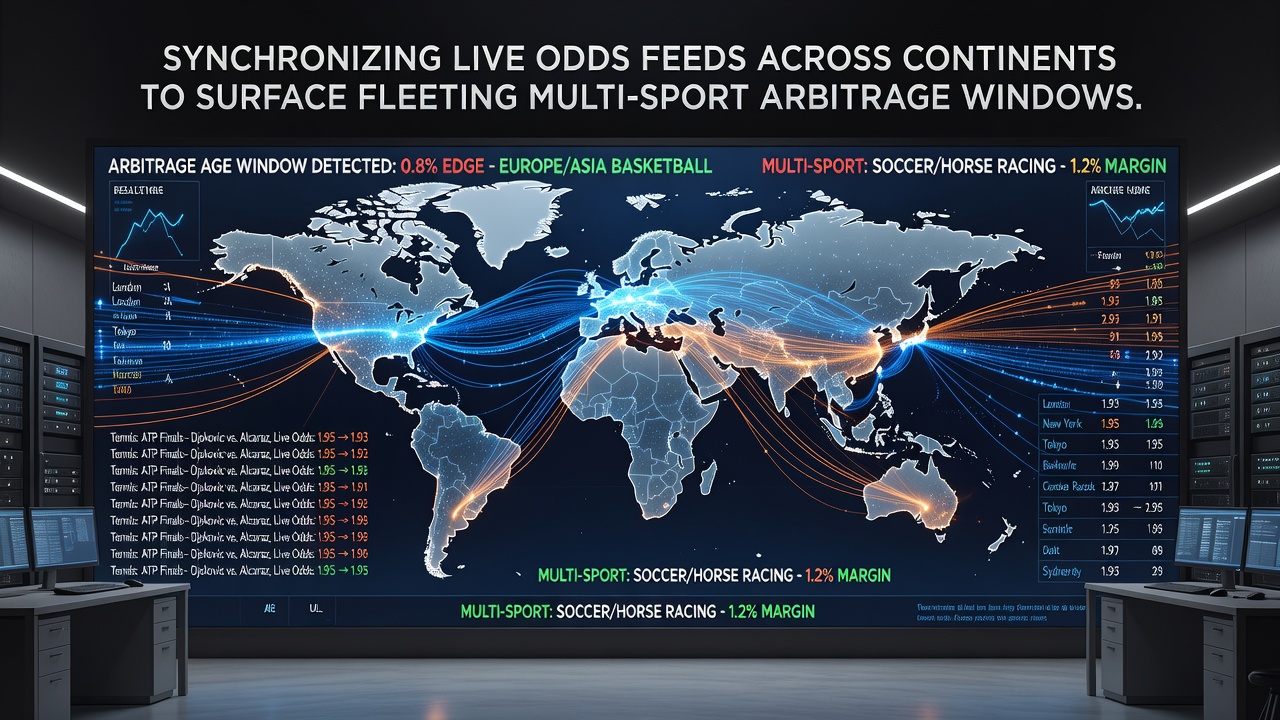
Network engineers route traffic through dedicated fiber paths and content-delivery points that reduce round-trip times below 80 milliseconds for the majority of European-to-US hops. Packet-loss mitigation protocols retransmit only changed price fields rather than entire market snapshots, which keeps bandwidth usage manageable even when hundreds of simultaneous events generate updates every few seconds.
Data Quality Controls and Latency Mitigation
Validation scripts compare incoming odds against historical volatility ranges for each market type; values falling outside three standard deviations trigger secondary confirmation requests before inclusion in arbitrage calculations. Redundant parsers run in parallel on separate virtual instances so that a single endpoint outage does not interrupt the overall stream. According to reports published by the American Gaming Association, major North American operators processed an average of 1.2 million live odds updates per hour during peak 2025 overlap periods, underscoring the scale that synchronization platforms must accommodate.
Geographic distribution of compute resources matters because regulatory frameworks differ by jurisdiction. Platforms licensed in Malta or Gibraltar maintain separate data-residency partitions for EU-sourced feeds while US-facing servers comply with state-specific record-keeping rules. This segmentation ensures that arbitrage detection remains functional without breaching local data-handling requirements.
Multi-Sport Correlation Logic
Correlation engines apply sport-specific weighting when combining soccer totals with basketball spreads or tennis set margins. A sudden shift in a Champions League under/over market may correlate weakly with an NBA moneyline movement, yet the system still evaluates both because independent bookmaker pricing errors can create synthetic risk-free combinations. Researchers at the University of Sydney documented that multi-sport arbitrage detection increased by 37 percent when feeds from five continents were merged into a single processing cluster rather than siloed by region.
October 2026 schedules show Champions League fixtures beginning at 20:00 CET on several midweek dates that coincide with NBA tip-offs at 19:30 and 20:00 EST. The resulting four-hour overlap window demands continuous feed health monitoring because any sustained latency above 150 milliseconds can erase the margin on low-vig markets that bookmakers refresh every 30 to 45 seconds.
Conclusion
Effective synchronization of live odds across continents rests on precise timestamp alignment, redundant low-latency connections, and sport-aware correlation rules that operate within regulatory boundaries. Platforms that maintain these capabilities surface brief multi-sport arbitrage opportunities during transatlantic fixture overlaps, including those expected in October 2026, without requiring manual intervention beyond initial configuration. Data from industry sources such as the European Gaming and Betting Association confirms that aggregated feed volumes continue to rise as more operators adopt real-time pricing, reinforcing the need for robust cross-border synchronization architectures.