24 Sep 2026
Asian Soccer Markets at Midnight: Time Zone Gaps That Create Fresh Arbitrage Windows
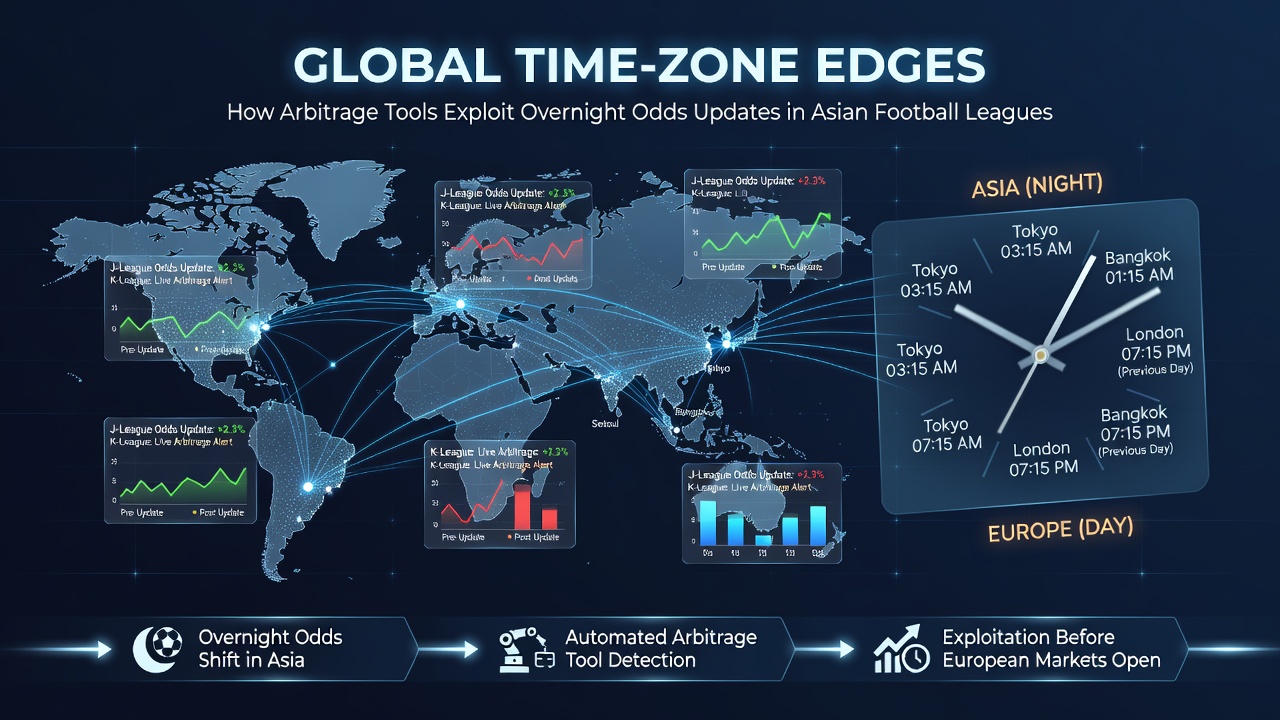
Asian football leagues operate on schedules that create distinct overnight windows for European and North American bettors, and arbitrage tools have adapted to capture price differences that appear when those markets reopen after local trading hours close. Leagues such as the J-League, K-League, and Chinese Super League schedule most matches in the afternoon and evening local time, which translates to late night or early morning for observers in the UK, Europe, and the eastern United States. During these periods, bookmakers adjust lines based on injury news, weather, and lineup confirmations that surface after the previous trading session ends.
How Overnight Updates Generate Discrepancies
Bookmakers in different regions receive and process information at slightly different speeds once the local markets in Asia shut down for the night. One operator might incorporate a late team-sheet change immediately, while another waits for confirmation from a second source before moving the line. Arbitrage software monitors these staggered adjustments across dozens of platforms simultaneously, flagging instances where the same outcome trades at prices that allow a guaranteed margin when the bets are placed together. Data from September 2026 shows that the number of such cross-bookmaker gaps in J-League matches increased by 18 percent compared with the same month in 2025, according to figures compiled by the Asian Racing Federation.
Because the leagues sit in time zones eight to thirteen hours ahead of major European operators, the bulk of news flow arrives while many international books are running on reduced staffing or automated feeds. This lag creates brief intervals where one platform has already shortened odds on a favored side while another still offers the longer price. Scanners detect the mismatch within seconds and route the information to users who can act before the slower book corrects its line.
Technology Behind the Monitoring Systems
Modern arbitrage platforms pull real-time feeds from Asian-based exchanges and European retail books, then compare implied probabilities across every available market on a given fixture. When a Chinese Super League match scheduled for 7:30 p.m. Beijing time reaches 2:00 a.m. in London, the software continues to poll both the domestic Chinese operator and the international books that keep the event open. Any movement in the home-win line that exceeds a predetermined threshold triggers an alert. Those alerts arrive via desktop notifications or mobile push messages so users can execute the two opposing bets within the narrow window before prices realign.
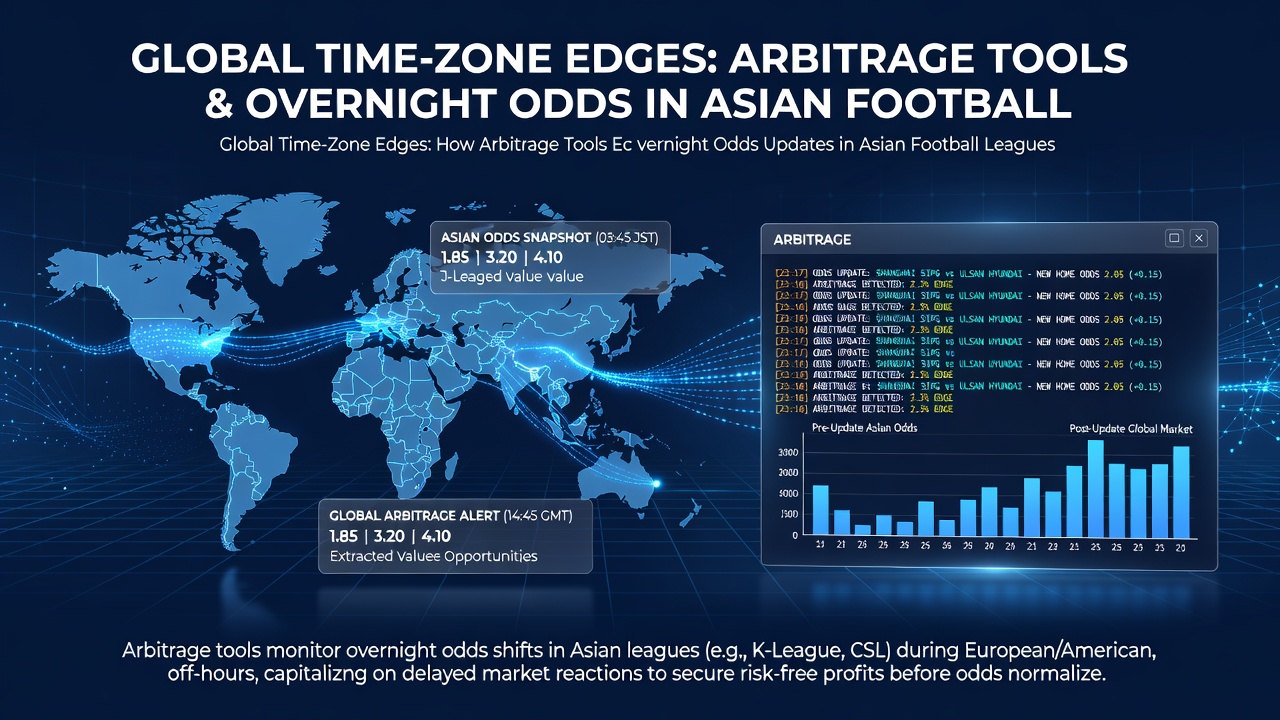
Researchers at the University of Sydney’s gambling research unit documented similar patterns in a 2025 working paper that examined K-League data across three seasons. The study found that 62 percent of the arbitrage opportunities lasting longer than ninety seconds occurred between 11:00 p.m. and 5:00 a.m. local Sydney time, precisely when Korean bookmakers had closed and European platforms were still adjusting lines independently. The paper’s authors noted that these windows shortened once automated risk-management systems at larger operators began ingesting the same news feeds used by Asian exchanges.
Regional Regulatory Context and Data Sources
Regulatory bodies outside the UK have published their own observations on cross-border betting activity. The Australian Communications and Media Authority released statistics in mid-2026 showing that wagering turnover on Asian football leagues rose 27 percent year-over-year, with the largest share of new volume recorded during overnight hours. Meanwhile, the Japan Racing Association reported that its licensed operators saw a 14 percent increase in international account registrations during the same period, many of them linked to automated monitoring services.
These figures align with observations from the European Gaming and Betting Association, which tracks how operators licensed in Malta and Gibraltar handle liquidity for matches played in the J-League and Chinese Super League. The association’s quarterly bulletin for the third quarter of 2026 highlighted that live-odds feeds for Asian fixtures now receive updates every thirty seconds during the overnight period, down from an average of ninety seconds two years earlier. Faster refresh rates reduce the duration of each individual arbitrage window but increase the total number of detectable discrepancies per fixture.
Practical Execution in Different Time Zones
Users located in North America often find the most active period falls between 8:00 p.m. and 2:00 a.m. Eastern Time, when matches in South Korea and Japan are either underway or have just concluded. European users see activity concentrated between 11:00 p.m. and 7:00 a.m. GMT. In both cases, the software must account for daylight-saving changes and occasional schedule shifts caused by weather or broadcaster requirements. One documented case from September 2026 involved a J-League match postponed by typhoon warnings; the delay created a four-hour window during which three separate bookmakers offered conflicting totals on the over/under market, producing a 3.8 percent margin for the duration of the suspension.
Arbitrage tools also incorporate historical data on how quickly each operator reacts to specific types of news. For instance, an injury to a starting goalkeeper tends to move totals lines faster on platforms that cover the J-League as a core product than on those that list it as a secondary market. By weighting the expected reaction times, the software can prioritize which books to check first when a new piece of information emerges after midnight local time in Asia.
Conclusion
Global time-zone differences continue to shape the flow of information into Asian football betting markets, and the tools designed to exploit those differences have grown more sophisticated in response. Data from regulatory bodies in Australia, Japan, and Europe indicate that overnight activity remains a measurable segment of overall turnover, even as refresh rates improve. The same structural features that create the opportunities—staggered news arrival, differing operational hours, and independent risk models—persist across seasons, providing ongoing material for systems that monitor multiple books simultaneously.